Weshoot.com

The Official We Shoot Blog

  • Home
  • About
  • To Comment

Posts Tagged ‘strobes’

We Shoot Photography Of The Day For 8/5/2019

Monday, August 5th, 2019

Click on image to enlarge.  Click again to enlarge to full size. 

Click on back button to return to post.

Click the “Home” tab above to see earlier posts.

Seattle Product Photography by We Shoot


Seattle Product Photography by We Shoot

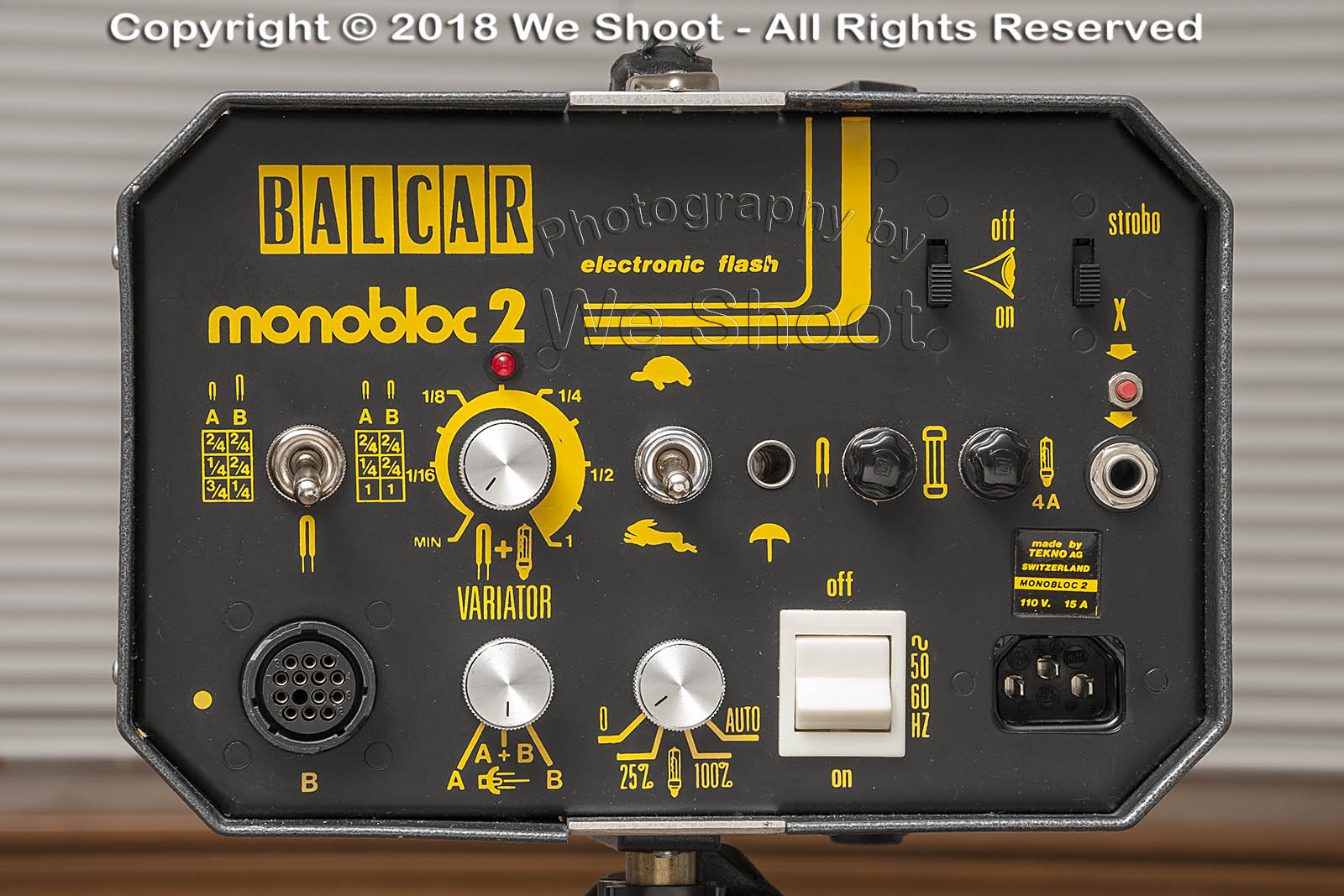
Balcar Monobloc 2 Studio Strobe Control Panel. Seattle Product Photography by We Shoot.

Tags: 1200, Balcar, equipment, flash, monobloc, pack, photo, photograph, photographic, strobe, strobes, studio, watt-seconds, ws
Posted in Information, Lighting, Marketing, Photographs, Images | Comments Off on We Shoot Photography Of The Day For 8/5/2019

Bracketing with Studio Strobes . . .

Friday, February 15th, 2013

Product and other forms of commercial photography sometimes require the use of strobes.  Strobes usually provide daylight color balance which helps with architectural photography as it allows a burst of light to light up a room, and use a time exposure to get the (daylight) scene outside a window so it looks like we see it.  Otherwise, the sunlit exterior is blown out, or in some instances, it can look darker and drearier than the interior, if it is overcast outside.  In the case of product, studio strobes are the powerful cousins of your on-camera strobes, and offer many advantages over the smaller units.

First, studio strobes are usually way more powerful, as they use very large batteries, 110v inverters, or wall socket power.  Second, they are portable and don’t have to be mounted on the camera, and give a more pleasing look as they don’t “flat-light” the subject and can be made to mitigate heavy shadows.  They are designed to work with many different accessories from umbrellas to soft boxes.  They can use many different types of wireless triggers.  They can generate more than enough light to shoot at tight apertures, allowing for deep depth of field.  In product and architecture, I find that shooting with small apertures (f11 to f16) allows me to get everything sharp and in focus.  If it is sharp in my original image, I can always create a shallow depth of field look in photo-editing software.  However, the reverse is not true.  Really soft images cannot be brought back into sharp focus even with the best of software.

All of the studio strobes I have used work with totally manual settings.  I usually set my camera on a tripod at f11 to f16 at 1/100th of a second or slower.  The strobe light burst lasts for a very short time.  This eliminates most movement, but how do I bracket under those conditions, since I don’t want to change either the shutter speed or aperture once I start shooting?  The answer is in the manual controls of the studio strobes.  Once I get my best-looking exposure of all elements by shooting and rechecking the image, I plan on shooting a series of images bracketed on either side of that exposure by working the slides or dials on my equipment, usually in half-stop increments.  I may be using as many as 3 or 4 lights at different angles, and each will need to be adjusted individually for each exposure.  This gives me the same object at the same depth of field at the same shutter speed from a dark exposure to an overblown exposure.  Why would I want to do this?  I can then pick and choose the best exposed parts of the object or room and using an editing program, such as Adobe Photoshop, I assemble them to make a perfectly exposed object with detail where it needs to be without any noise.  I can also make an HDR image from all the exposures, if that gets me a better-looking image.

Being a commercial photographer means getting the best satisfactory image for your client.  A commercial photographer having the right equipment and expertise means leaving very little to chance.

– Gary Silverstein

We Shoot

We Shoot is a commercial product, food, industrial, and architectural photography team based in the Seattle area.

Tags: architectural, bracketing, commercial, edit, flash, flat-light, flat-lit, food, hdr, industrial, lighting, off-camera, on-camera, photography, Photoshop, product, shadow, software, strobes, studio strobes
Posted in How To, Learning, Tips | Comments Off on Bracketing with Studio Strobes . . .

One Cool Picture

Saturday, June 26th, 2010

As I sit here, an old friend comes to mind.  A camera repairman in Los Angeles.  Whenever I had any trouble with a camera, I’d go to Marvin.  He may have been around fixing cameras for Ansel Adams back in the day, as far as I know.  He knew everything – and I mean everything – about cameras and their operation.  I often think of how great he was at his job in his off-the-beaten-path repair shop, and how so many people weren’t aware of his business, and didn’ t know of his talent.

I knew another talented professional – an auto repairman – who got lost in the shuffle because of his far-out location.  His customers relied upon him every time they needed a repair.  On occasion, they’d mention him to a friend, but in this busy world many of us neglect to talk of such things to others and, like so many professionals, this repairman had days when no business came in, as was the case with my camera repairman.

One day, I got a call from the auto repairman requesting I take a photograph of him to accompany a newspaper ad about his business.  I suggested an image of him working over a car engine, and even though many newspaper ads don’t work, this one did.  People shuffle through their paper and flip through their magazines.  They barely take notice of their trade periodicals, oftentimes not even noticing the articles, let alone the ads.  Why did this one work?  I’d like to think it was because of this picture, and maybe it was.  New customers responding to the ad would mention it when they called for an appointment or when they came in to see him.  “What a cool picture!”  And as they got to know him, they’d say, “watching you work on my car reminds me of that newspaper photograph.”  Apparently the image seemed to say to them, “I care about what I’m doing.  I care about doing a good job.”

In the case of this wonderful automotive technician, they were right.  This mechanic cared, just like my camera mechanic cared.  Did the photo say that to the people who responded to the ad?  Apparently so.  Looking at it from that viewpoint, it’s not necessarily advertising that brings in the work, but the kind of advertising.  In this case, advertising with photography.  (An interesting anecdote:  no customer seemed to recall that the photograph was accompanied by an ad, even though it obviously was since it brought the new customer to his business, but the picture was what stood out.)

What made the image work?  Was it the sparkle in his eye – made even more luminous by our professional strobes?  Was it the highlight on his wrench – made even more powerful with my assistant’s precise positioning of the mechanic’s hand?  Whatever it was, without the picture, the ad in this case may not have even been noticed.

There are many professionals like these two mechanics.  Do you know of some?  If so, reach out to them.  Tell everyone about them.  Hey, even better.  Take his or her picture.  A good one . . . shot with care.

 – Dione Benson

Tags: ad, advertisement, advertising with photography, ansel adams, auto mechanic, auto repair, camera, photograph, picture, referrals, repair, strobes, technician
Posted in Marketing | Comments Off on One Cool Picture

  • Categories

    • How To (21)
    • Information (548)
    • Learning (30)
    • Lighting (179)
    • Marketing (291)
    • Photographs, Images (545)
    • Tips (38)
    • Uncategorized (2)
    • video (13)
  • Archives

    • September 2025
    • June 2025
    • May 2025
    • April 2025
    • January 2025
    • December 2024
    • November 2024
    • September 2024
    • August 2024
    • July 2024
    • June 2024
    • May 2024
    • April 2024
    • March 2024
    • February 2024
    • December 2023
    • November 2023
    • October 2023
    • September 2023
    • August 2023
    • July 2023
    • May 2023
    • February 2023
    • January 2023
    • October 2022
    • September 2022
    • August 2022
    • July 2022
    • March 2022
    • February 2022
    • January 2022
    • December 2021
    • July 2021
    • June 2021
    • May 2021
    • April 2021
    • March 2021
    • February 2021
    • January 2021
    • December 2020
    • November 2020
    • October 2020
    • September 2020
    • August 2020
    • July 2020
    • June 2020
    • May 2020
    • April 2020
    • March 2020
    • February 2020
    • January 2020
    • December 2019
    • November 2019
    • October 2019
    • September 2019
    • August 2019
    • July 2019
    • June 2019
    • May 2019
    • April 2019
    • March 2019
    • February 2019
    • January 2019
    • December 2018
    • November 2018
    • October 2018
    • September 2018
    • August 2018
    • July 2018
    • June 2018
    • May 2018
    • April 2018
    • March 2018
    • February 2018
    • January 2018
    • December 2017
    • November 2017
    • October 2017
    • September 2017
    • August 2017
    • July 2017
    • June 2017
    • May 2017
    • April 2017
    • March 2017
    • February 2017
    • January 2017
    • December 2016
    • November 2016
    • October 2016
    • September 2016
    • August 2016
    • July 2016
    • June 2016
    • May 2016
    • April 2016
    • March 2016
    • February 2016
    • January 2016
    • December 2015
    • November 2015
    • October 2015
    • September 2015
    • August 2015
    • July 2015
    • June 2015
    • May 2015
    • July 2014
    • June 2014
    • May 2014
    • September 2013
    • June 2013
    • March 2013
    • February 2013
    • January 2013
    • December 2012
    • October 2012
    • July 2012
    • June 2012
    • May 2012
    • March 2012
    • February 2012
    • December 2011
    • September 2011
    • August 2011
    • July 2011
    • March 2011
    • December 2010
    • October 2010
    • September 2010
    • July 2010
    • June 2010
  • Meta

    • Log in
    • Entries RSS
    • Comments RSS
    • WordPress.org

Copyright © 2025 - weshoot.com | Entries (RSS) | Comments (RSS)

WordPress theme designed by web design