Weshoot.com

The Official We Shoot Blog

  • Home
  • About
  • To Comment

Posts Tagged ‘We Shoot Photography’

Going off, half-cocked!

Monday, June 24th, 2013

Sometimes it pays to do your homework.  Don’t just read the headlines.  Several times in the last few years, I have gotten some strange phone calls.  One day, late in the afternoon, I got a call on our business line.  A woman breathlessly asked, “How late are you open?”  I was somewhat taken aback by this, as we are basically location photographers who have a studio, but do most of our work outside of it.  We have used the studio for food and small product shooting, but our work is mostly on location: commercial, industrial, large product, and architectural.

So it was surprising to get a call like this, and I said to the person on the other end that we are open 24/7.  Whenever a client needs us, we are there.  Then the caller said, “Do you have an indoor range?”

I realized that this caller had only read our headline on a search engine, and typed in “Shooting Range” for their search.  In the headline, a lot of times, our phone number comes up.  So, instead of clicking on the link to get more information, they call our number.

I told the caller that the name of our business is We Shoot, that we are commercial photographers – the only things we shoot are cameras – and that our website is weshoot.com.  She sounded a little sheepish and apologized for calling.  And, she still hadn’t found a shooting range, which I assumed she was in a hurry to find.

In like respect, when choosing a commercial photographer for a project, see if they are what you are looking for.  Many photographers who specialize in weddings also advertise for other types of work.  Now, this is not to say that wedding photographers can’t do commercial work, but if you go to their website and the first images you see are wedding related or portraiture heavy, this is what comprises the bulk of their work.   You won’t find weddings or portraits on our website.  Just because we all use cameras doesn’t make us all the same.  So, choose wisely for the type of photography you need – it can save you time and money in the long run.  Then you won’t be going off, half-cocked!

– Gary Silverstein

We Shoot

Tags: architectural, architecture, commercial, industrial, photography, product, We Shoot Photography, weshoot.com
Posted in Information | Comments Off on Going off, half-cocked!

Bracketing With Hot Lights And Available Light . . .

Wednesday, January 16th, 2013

In my last post, I discussed bracketing of exposures.  Today, let’s talk about bracketing with hot lights.  Hot lights are a continuous lighting source and should be regarded as available light, just sometimes very intense, and very bright.  A majority of hot lights are of incandescent color temperature, adding a warm or yellow tone to your image.  In most modern DSLRs, there is a setting for tungsten or incandescent light which compensates for the warm tint by adding a blue or cyan tint to the image.

Instead of using the incandescent mode in the camera for white balance, I prefer taking one exposure with a gray card in the image and setting the gray reading for all the images I take in that series with my editing software.  Outdoors, my cameras are very accurate, so the automatic white balance setting works just fine.  Indoors with a mix of lighting, a gray card or an Expodisk is the ticket.

Now, back to bracketing with available light and hot lights.  My cameras will do up to nine bracketed shots (different exposures of the same image) automatically.  Some cameras only allow three images for auto bracketing.  If you desire more exposures for either HDR (High Dynamic Range) images or for layering the images with these cameras, the way to facilitate that is to do it manually.  As in my last article, adjust the exposure by putting the camera in aperture-priority mode, setting one aperture and changing the shutter speed to bracket various exposures.  My choice is to use 2/3 of a stop difference for each of my brackets.  You may like 1/3 stop, 1/2 stop, 1 stop, or ? bracketing stops instead.  If doing this manually, try to get one optimum exposure, i.e. the one picked by the camera as the overall best exposure, and make the same number of exposures brighter and darker on either side of the optimum exposure.  Also, if doing it manually, you will have to put the camera on full manual for exposure, then set your aperture where you want and vary the time for the brackets.

The reason for bracketing is that the latitude for digital images is about 5 stops with detail and no digital “noise.”  When lightening darker areas in a digital image, one sometimes runs into noise, either color noise which looks likes flecks of red, green, and/or yellow in that area, or luma noise, which looks like flecks of black snow.  Noise is usually unacceptable in commercial work and for stock images.  The answer is to bracket and take images in which even shadow areas are light enough to have detail without the need to lighten them, and to blend them into the finished image, either with HDR or layering and masking in computer-editing software.  Conversely, blown-out areas of one image can be recovered from a darker bracketed image, and give detail to blown-out areas.

In summary, bracketing with available lighting or with hot lights is basically the same, and white balance should be checked and adjusted should the need arise.

-Gary Silverstein


Tags: bracket, bracketing, brackets, commercial photography, editing, exposure, exposures, hdr, hot lights, image, layer, layering, lights, photography, Photoshop, professional, software, We Shoot Photography, weshoot.com
Posted in How To, Learning, Tips | Comments Off on Bracketing With Hot Lights And Available Light . . .

How to take more professional images . . .

Tuesday, August 9th, 2011

We just finished a product shoot where the client first tried to take the pictures himself.  That did not give him the results he wanted for his business promotion.   He called a friend with “A really good camera,” and the results were, shall we say, less than stellar.   He called us and showed us the images his friend had taken.   While he indeed may have had a really good camera, his friend lacked the skills and equipment necessary to show the products in the absolute best light (pun intended).   For most product photography, it is all about the lighting and knowing how to use it.   It is not about the camera, lens, or resolution (sufficiency in each is all that is needed).   Quality of lighting – diffused or harsh, color of lighting, and its relationship to white balance are all factors.   Lighting shape is a factor – square, round, or some other shape.   How will the light reflect off the subject?    Using an umbrella to spread out the light when shooting a mirrored surface will show the ribbing in the umbrella in reflection.   Is a spotlight required?   How is that accomplished?   When should one use continuous lighting (such as hot lights), or should one use strobes?   What are the advantages of each?

When we were done and presented the final images to our client, he said that he felt bad that he wasn’t using his friend’s images.   But then he said this was about making money from his business and increasing same, and although he didn’t want to make his friend unhappy, he wanted to use these images to make money.   And that is the bottom line.   I am including some images as samples.   They have nothing to do with the above-mentioned product shoot, but are being used for illustrative purposes only.

Sample 1 is an image I took to illustrate really poor photography.   I used the flash built into a pro-sumer DSLR and the image is badly out of focus (on purpose).   It is underexposed.   It is taken against a dark busy background, and there is no editing whatsoever of the image.   I have seen shots like this on eBay, and even company websites when someone is trying to promote their products – anything from a widget to a building.   Except for the fact that the image cost nothing to create (once the camera has been purchased), there is nothing good to say about it.   In fact, bad photography could be hiding flaws in the product, as far as the viewer knows.   If the photography is bad, whatever the company is selling is suspect – if corners are cut with the photos, what corners were cut with the product?   For a better chance at selling an item with a photograph, a bit of work will be involved.

poor amateur product image

Sample 1 - Click to Enlarge

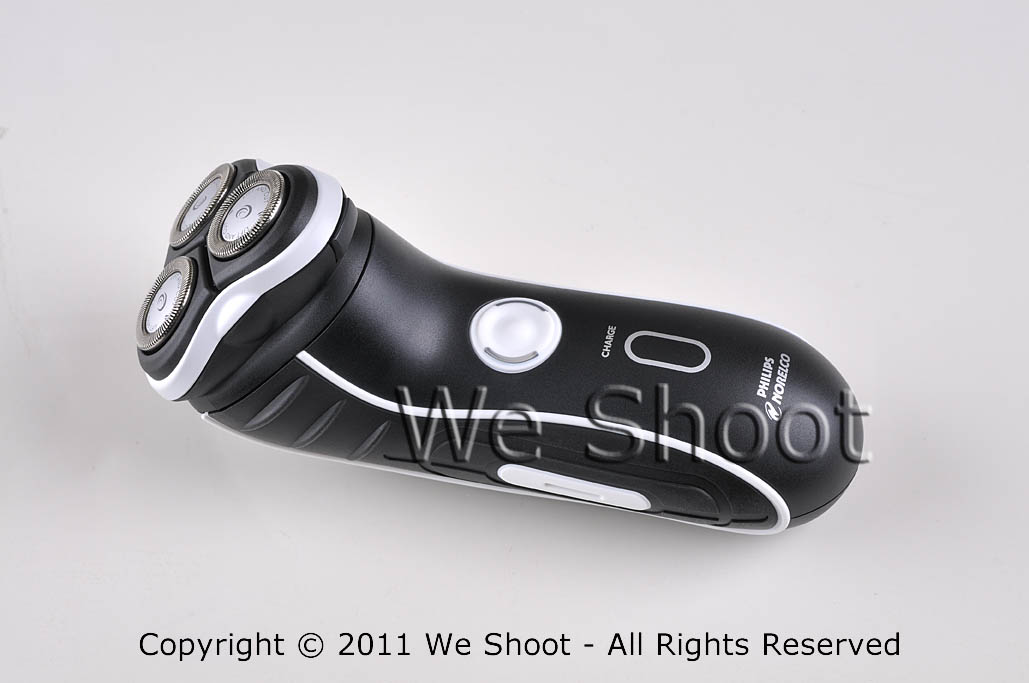
Sample 2 is against a white fomecore background and had two AC-powered studio strobes with soft boxes opposite each other at each end of the shaver to show texture in the shaver, and to highlight  stainless steel cutting heads.   The soft boxes spread light out with very diffused lighting and bring out a lot of detail with no harsh shadows.   There is some minor enhancement with Photoshop in this sample.

Basic well-lighted product image

Sample 2 - Click to Enlarge


In sample 3, I have made a “clipping path” to trace out the shaver from the original background, rotated the image vertically, and made a background layer with Photoshop in which I made a gradient of black and red.   Some more enhancement was done with Photoshop, including making the glowing yellow-green lights on either side of the on-off switch to simulate the look when the shaver is switched on.   Now you may ask why I didn’t take it with the shaver “on,” instead of simulating the look.   First, the shaver probably wouldn’t stay in position with the vibration of the shaver running, and also because I had more control of how it looks in the output this way.

weshoot.com product image

Sample 3 - Click to Enlarge

Now, which sample image would you choose to promote your product?

I will help you get close to sample 2 results, but you have to have some other props and accessories and do extra work to get there.  First get something white (for a dark subject) as a background , like a piece of fomecore.   It also helps reflect white light onto a dark object.   If shooting a light-colored or white object, you might want to go with gray or black as a background to contrast.   Next, go to a store like Lowe’s or Home Depot and buy several clamp light housings (see http://bit.ly/o3p5cP ) and a commensurate number of daylight compact fluorescent bulbs.   This won’t work as well as strobes with soft-boxes, but it will beat using a camera-mounted strobe.   Try different lighting positions until you get the lighting, shadows, and highlights you desire.   You will also need a tripod and a camera capable of taking a time exposure and allowing the flash to be deactivated.   You may also need to set the white balance (check your camera or editing program documentation to see how to do that ).   Make sure to get sharp focus.   Getting too close to the subject reduces depth-of-field, and some part of the subject will go out of focus.   Take several shots at different exposures to get the best one.   It may take more tries to get exactly what you want.

To get to sample 3 results, you will need a photo-editing program, and know enough on how to work with images for given results.   That is not within the scope of this article.  Really good product image editing takes knowledge, experience, and patience.   It can be time consuming and a lot of hard work.   It also helps to know a few enhancement secrets and have a lot of Photoshop experience.  That’s why I still get work, even if my client has a “really good camera.”

– Gary Silverstein

Tags: commercial product photography, product photographer, We Shoot Photography, weshoot.com
Posted in How To, Learning, Tips | Comments Off on How to take more professional images . . .

  • Categories

    • How To (21)
    • Information (548)
    • Learning (30)
    • Lighting (179)
    • Marketing (291)
    • Photographs, Images (545)
    • Tips (38)
    • Uncategorized (2)
    • video (13)
  • Archives

    • September 2025
    • June 2025
    • May 2025
    • April 2025
    • January 2025
    • December 2024
    • November 2024
    • September 2024
    • August 2024
    • July 2024
    • June 2024
    • May 2024
    • April 2024
    • March 2024
    • February 2024
    • December 2023
    • November 2023
    • October 2023
    • September 2023
    • August 2023
    • July 2023
    • May 2023
    • February 2023
    • January 2023
    • October 2022
    • September 2022
    • August 2022
    • July 2022
    • March 2022
    • February 2022
    • January 2022
    • December 2021
    • July 2021
    • June 2021
    • May 2021
    • April 2021
    • March 2021
    • February 2021
    • January 2021
    • December 2020
    • November 2020
    • October 2020
    • September 2020
    • August 2020
    • July 2020
    • June 2020
    • May 2020
    • April 2020
    • March 2020
    • February 2020
    • January 2020
    • December 2019
    • November 2019
    • October 2019
    • September 2019
    • August 2019
    • July 2019
    • June 2019
    • May 2019
    • April 2019
    • March 2019
    • February 2019
    • January 2019
    • December 2018
    • November 2018
    • October 2018
    • September 2018
    • August 2018
    • July 2018
    • June 2018
    • May 2018
    • April 2018
    • March 2018
    • February 2018
    • January 2018
    • December 2017
    • November 2017
    • October 2017
    • September 2017
    • August 2017
    • July 2017
    • June 2017
    • May 2017
    • April 2017
    • March 2017
    • February 2017
    • January 2017
    • December 2016
    • November 2016
    • October 2016
    • September 2016
    • August 2016
    • July 2016
    • June 2016
    • May 2016
    • April 2016
    • March 2016
    • February 2016
    • January 2016
    • December 2015
    • November 2015
    • October 2015
    • September 2015
    • August 2015
    • July 2015
    • June 2015
    • May 2015
    • July 2014
    • June 2014
    • May 2014
    • September 2013
    • June 2013
    • March 2013
    • February 2013
    • January 2013
    • December 2012
    • October 2012
    • July 2012
    • June 2012
    • May 2012
    • March 2012
    • February 2012
    • December 2011
    • September 2011
    • August 2011
    • July 2011
    • March 2011
    • December 2010
    • October 2010
    • September 2010
    • July 2010
    • June 2010
  • Meta

    • Log in
    • Entries RSS
    • Comments RSS
    • WordPress.org

Copyright © 2025 - weshoot.com | Entries (RSS) | Comments (RSS)

WordPress theme designed by web design