Weshoot.com

The Official We Shoot Blog

  • Home
  • About
  • To Comment

Posts Tagged ‘camera’

Bracketing Different Exposures . . .

Saturday, December 15th, 2012

Let’s talk about the art of bracketing.  Bracketing is taking the same image at several  different exposures so you are sure to get the detail you desire in your images during digital post-production.  You may want to use high dynamic range (HDR) features in your computer software or camera to combine the exposures into one homogenous image, preserving both shadow and highlight detail from all the different exposures.  Or, if you prefer, you can use editing program masking techniques which allow the use of layers to achieve the same goal, but with more of a standard photographic look to your work.  HDR is sometimes difficult to work with to get an image that looks like what we have come to accept as “a photographic look,” and instead seems to have the feel of an illustration.

You can bracket manually, or some cameras will allow automatic bracketing in their menus.  My work cameras will allow 3, 5, 7, or 9 images to be taken automatically at a set rate of exposure variance, which I can specify (generally for me at 2/3 of a stop).  Using this method, I usually set the camera to alter the shutter speed from overexposed to underexposed.  I recommend shooting in aperture priority and altering the shutter speed as it keeps the aperture the same.  If you bracket by changing the aperture, sizes of things in the resulting images will be slightly larger or smaller in each exposure depending on the aperture dimension.  This will make it difficult to properly align each image.  I don’t recommend hand-holding the camera as it introduces camera shake and misalignment and, therefore, I usually use a tripod for bracketing.

In future posts, I will be touching more on bracketing and working with strobes, and hot lights, and how you can work on these in an editing program.

-Gary Silverstein

Tags: bracket, bracketing, camera, exposure, hdr, high dynamic range, layering, masking, multi-exposure, over expose, under expose
Posted in How To, Learning, Tips | Comments Off on Bracketing Different Exposures . . .

The Difference A Background Can Make . . .

Monday, October 1st, 2012

In the days of film, a professional commercial photographer had to be very careful of the backgrounds that would be used in his/her images.  Retouching was expensive.  Shooting an item for use against another background from the one it was taken with could be a labor-intensive multi-step process.  A spot on a high-key (pure white) background  could be touched out on the negative, and a nightmare undertaking on a transparency.   Today, of course, images are taken digitally and manipulated by editing programs, like Photoshop.  One of our most recent shoots involved large, heavy industrial products.   In film-days past, we would have probably used a seamless white background to shoot the product and spent a lot of time with product placement.  The items to be photographed were round, between two and three feet in diameter, and each weighed 500 or more pounds.  Five views were to be taken of each.  That means that either the item would have to be moved on the background, or very carefully lifted by a hoist onto the background.  We would have to be careful of marks left by the items where they rested on the paper, and some method of keeping such round items from rolling off the surface would have to be employed and kept out of sight.

So, pre-planning for the shoot is still important, even in this digital world.  We opted to not use any type of manufactured background per se, but to only use white reflectors in strategic places to reflect light or add a highlight where we desired.  Not using a background simplified the lighting somewhat in that a roll of paper or fabric didn’t block out the light from behind each item.  We were going to photograph the items in the factory environment with the idea that we would isolate the image in Photoshop, and put it on another, more desirable background.

Lighting was done with our powerful studio strobes, and the modeling lights on the strobes gave us an idea of how the lighting would look in the finished image.  We shot with soft-boxes to give a square look to our lighting in the highlights, as umbrellas just wouldn’t cut it here as these products were light-reflective.  We planned to keep the camera stationary, move the lights as necessary, and rotate the product for the five different angles the customer required.  Since the objects were circular,  and we wanted to keep all the images the same size, we had to plan how to keep that proportionality.  Think of a coin stood on edge.  The widest the image would have to be is a little more than the diameter when one of the faces of the coin is toward you.  When the edge of the coin is nearer to you, the size of the image could change, but we wanted to make them all the same size for the client’s ease of putting together several views of their product.  Also, we had to be far enough away to assure depth of field when we were shooting the views that showed part of the object furthest away.  Editing programs have great sharpening utilities, but a severely out-of-focus image cannot be brought back.  You can easily blur parts of a sharp image and make it look good if needed for the effect, but the reverse isn’t the case.  So all this had to be figured out in advance.

Now, let’s go on to the backgrounds for the images.  Since the area or table on which the items were shot was in a fixed location, the background for each image (as produced by the camera) would have been a toolbox and other parts of the assembly plant.  So we made it so that we and our client could “lift” the item off the background and put it on any other background or even a video.  This is done by means of a “clipping path.”  This is a very labor-intensive process.  It means that I use a Photoshop tool to painstakingly trace out every edge of the product at anywhere from a 100% to a 300% enlargement.  Once I have outlined every hole, edge, and cranny, I “select” the item alone and make a layer of it to put on other backgrounds.  I include this clipping path with the image, so the client is able to do the same.  Now, you may ask why I do so much work, as some of the editing programs have become pretty sophisticated and make an easier selection with other, faster tools.  Well, the answer is this:  I have used these editing tools, and sometimes there are errors in the program choosing what is part of the item and what is not.  It may not be noticeable on a small jpeg on a website, but it will stick out like a sore thumb on a 30X40 enlargement at a trade show.  That is what separates a pro from an amateur.  Below are an original view of one of the products, and a few different backgrounds that I feel work well.  Each background below was created in Photoshop, but other backgrounds could be used, as well.  Remember that whichever one a client chooses, I include the clipping path so they can put it against another background if that is their need.
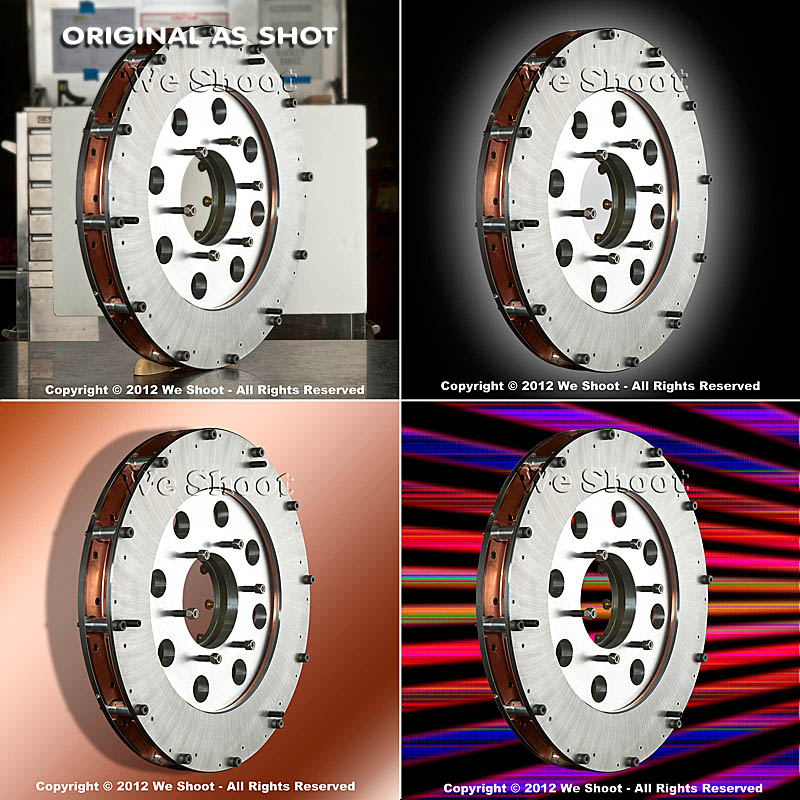
As you can see, the product image looks at home with any of the backgrounds.  Keep this in mind as you plan your next shoot.

– Gary Silverstein

Tags: camera, commercial photographer, commercial photography, http://weshoot.com, Marketing, photographer, photography, Photoshop, professional, reflections, video
Posted in How To, Learning, Tips | Comments Off on The Difference A Background Can Make . . .

One Cool Picture

Saturday, June 26th, 2010

As I sit here, an old friend comes to mind.  A camera repairman in Los Angeles.  Whenever I had any trouble with a camera, I’d go to Marvin.  He may have been around fixing cameras for Ansel Adams back in the day, as far as I know.  He knew everything – and I mean everything – about cameras and their operation.  I often think of how great he was at his job in his off-the-beaten-path repair shop, and how so many people weren’t aware of his business, and didn’ t know of his talent.

I knew another talented professional – an auto repairman – who got lost in the shuffle because of his far-out location.  His customers relied upon him every time they needed a repair.  On occasion, they’d mention him to a friend, but in this busy world many of us neglect to talk of such things to others and, like so many professionals, this repairman had days when no business came in, as was the case with my camera repairman.

One day, I got a call from the auto repairman requesting I take a photograph of him to accompany a newspaper ad about his business.  I suggested an image of him working over a car engine, and even though many newspaper ads don’t work, this one did.  People shuffle through their paper and flip through their magazines.  They barely take notice of their trade periodicals, oftentimes not even noticing the articles, let alone the ads.  Why did this one work?  I’d like to think it was because of this picture, and maybe it was.  New customers responding to the ad would mention it when they called for an appointment or when they came in to see him.  “What a cool picture!”  And as they got to know him, they’d say, “watching you work on my car reminds me of that newspaper photograph.”  Apparently the image seemed to say to them, “I care about what I’m doing.  I care about doing a good job.”

In the case of this wonderful automotive technician, they were right.  This mechanic cared, just like my camera mechanic cared.  Did the photo say that to the people who responded to the ad?  Apparently so.  Looking at it from that viewpoint, it’s not necessarily advertising that brings in the work, but the kind of advertising.  In this case, advertising with photography.  (An interesting anecdote:  no customer seemed to recall that the photograph was accompanied by an ad, even though it obviously was since it brought the new customer to his business, but the picture was what stood out.)

What made the image work?  Was it the sparkle in his eye – made even more luminous by our professional strobes?  Was it the highlight on his wrench – made even more powerful with my assistant’s precise positioning of the mechanic’s hand?  Whatever it was, without the picture, the ad in this case may not have even been noticed.

There are many professionals like these two mechanics.  Do you know of some?  If so, reach out to them.  Tell everyone about them.  Hey, even better.  Take his or her picture.  A good one . . . shot with care.

 – Dione Benson

Tags: ad, advertisement, advertising with photography, ansel adams, auto mechanic, auto repair, camera, photograph, picture, referrals, repair, strobes, technician
Posted in Marketing | Comments Off on One Cool Picture

Reflecting on Reflections, Part 2

Thursday, June 24th, 2010

Without a doubt, the hardest single thing I ever photographed was, of all things, something so ubiquitous that we handle them every day.  I am talking about door knobs.  Plain, highly reflective, brass doorknobs.  Now, why is it so hard to photograph a doorknob?  Well, it becomes a lot more difficult when there are some rules.  Rules like one would run into with a doorknob manufacturer looking for someone to shoot images of their products for promotions.  Do you think they want a reflected image of a happy, smiling distorted photographer looking out from their new brochure at the viewer?  How about seeing that photographer’s camera and tripod, or the space the doorknob happens to be in?  Simple, inexpensive, plain, highly polished brass doorknobs become painful to contemplate as a product photographer.  They not only are spherical and reflect the entire world around them, they have a backing plate made of the same stuff, that will reflect things that exist behind the knob, from the reflection on the back of the knob.  

Several years ago, we had spoken with a potential client, the marketing department head at a large manufacturer of doorknobs, hardware, and faucets about working for her company.  She said she had several photographers she used for shooting these products, but she said she would send us a sample of their products so that we could submit a test photograph to show that we could handle this type of photography, in case she needed our services.  Parameters for shooting this product were clear.  Shoot it on a 4″X 5″ transparency, and no retouching of any kind was permitted.  She said they did any retouching needed at the graphics department at the manufacturer.  

About 5 days later, the product arrived by UPS.  There was a plain brown cardboard box inside the outer package.  I opened it up and beheld a photographic nightmare.  It was an inexpensive, highly-polished brass doorknob set, complete with keys.  

It reflected everything!  It saw me, the room, everything in the room, and to my horror, the backing plate re-reflected everything the back of the knob “saw.”  I knew this was to be a fight.  I looked at images of doorknobs in advertising.  They looked perfect.  Some were “brushed” metal – not polished, but still shiny.  Some were dull finished, and just reflected highlights.  The polished ones stood out.  No reflections of photographers, cameras, tripods, rooms, etc.  I assumed that there was some reflection of a camera lens somewhere during the taking of the image, as there was no way to avoid the reflection from the angle presented.  A different angle may have allowed one to position the lens where the reflection would be positioned over the keyhole, but you can’t shoot there for different angles.  The first problem includes camera, tripod and photographer reflections.  One way to avoid this taking up a lot of room on the doorknob is to make a blind out of white material, like foam core, and cut a hole through which the camera lens “sees” the doorknob.  

Although this cuts down on untoward reflections, it still reflects the lens and the hole, unless the hole is dark and tight around the lens.  I figured this made for a minimum of retouching at the graphics department, and would be acceptable.  A second consideration was the lighting.  Lights or hot spots show up on the product itself and a smooth highlight with no hot spots would be a better solution.  Everything I tried did not work!  As said before, putting a piece of foam core in front of the doorknob cut down reflections, but I thought that aiming lights from behind the doorknob and bouncing the light toward the white foam core blind would produce the effect without bad reflections.  I was wrong.  The strobe “soft boxes” reflected into the back side of the door knob and re-reflected off the backing plate.  I had distorted oblong light reflections staring at me from the backing plate.  

It became evident there must be a way to do this.  I tried white sheets, but the lights created hot spots, and it reflected any corners and folds.  I had seen a shooting tent at my local pro camera store, and headed down there next.  A tent like this was used to evenly light small products and I thought this was the ticket.  It cost $250.00 plus tax.  I got the tent home, and assembled it.  It was made of a translucent white fabric, meant to diffuse the light inside.  It also was rigid and had seams and a rigid frame inside the fabric which showed up in the reflections.  It had several holes for camera placement, and try as I might with stuff to cover them, they showed up, too.  Fortunately, I was able to return the tent for a refund as it really didn’t do the job.  

I even talked to man who owned a company that made plastic blister packs in Santa Barbara.  I drove out to Santa Barbara to get a prototype dome of a transparent, but clouded plastic that he was thinking of producing.  It took out most of the distracting reflections, but reflected the cloudy nature of the dome and made the doorknob appear dull and not highly reflective.  I sent it back to Santa Barbara with a thank you note and a description of the effect.  

I finally built a box enclosure of translucent white plastic, got what I thought was a good image and sent that to the marketing manager.  She said to keep the doorknob, and she would call us if she needed us.  Last I heard, she was working for another company doing something completely different.  She never called!   

Below is the image I created, after scanning it and retouching it for our portfolio.  Shiny, reflective doorknobs are tough.  Try it if you doubt me.  

– Gary Silverstein      

Doorknob with minimal reflections - click on image to enlarge

Tags: 4x5, camera, photography, Photoshop, reflecting, reflections, retouch, shoot, shooting, view, view camera
Posted in Learning | 10 Comments »

Reflecting on Reflections, Part 1

Saturday, June 19th, 2010

I was once asked about the hardest thing I ever photographed.  Of course there have been several difficult things to shoot, but as a commercial photographer, some product and catalog shoots and reflective objects just jump out.  Reflecting on a number I have done, I think they have gotten a bit easier for me with time, either because of experience, or the ability to use digital retouching and enhancement techniques, or both.  To say that there are no more challenges would be a misstatement, however.

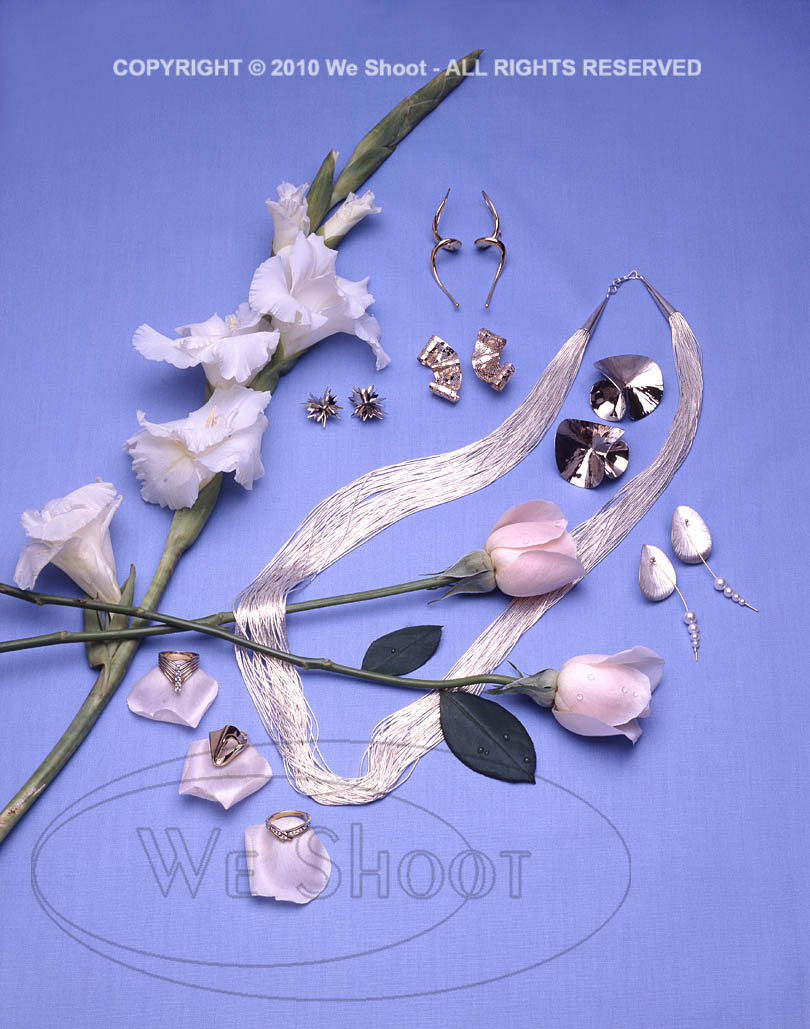
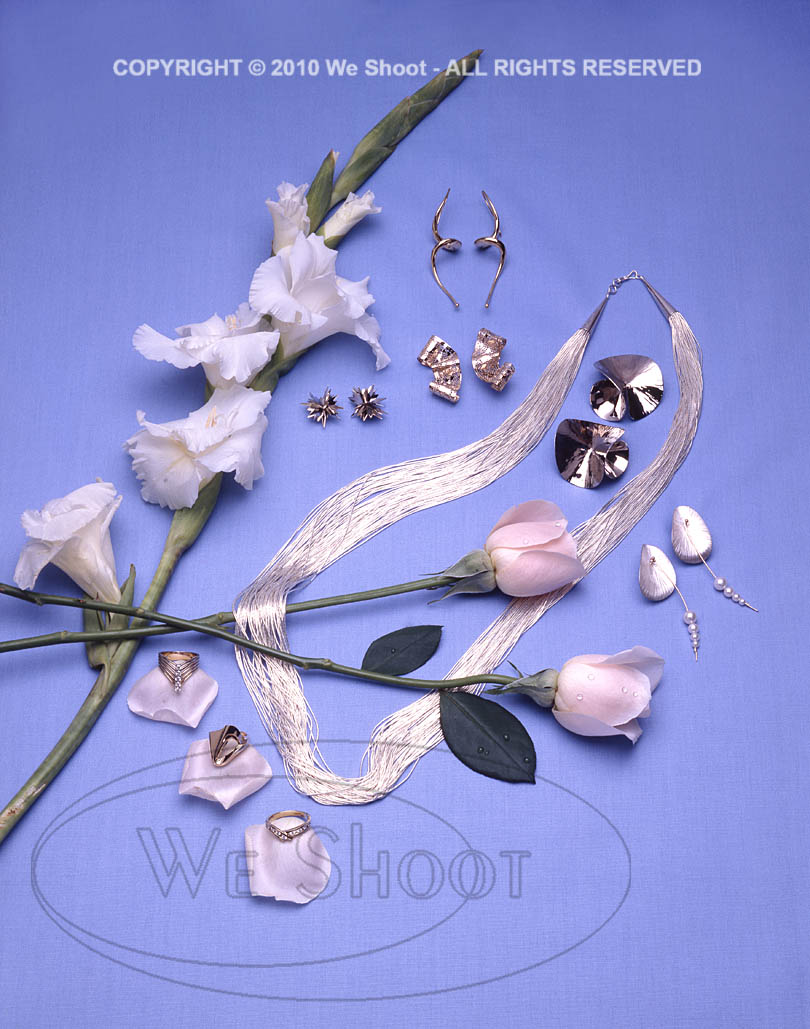
My first bout with reflective product shots came during the era of film, long before digital capture or scanning was even possible.  Digital retouching was a pipe dream for the future.  I was asked to photograph jewelry with a large-format view camera (a 4X5) on transparencies.  We opted to use our then-considered-powerful 1200 watt-second Balcar studio strobe set for lighting.

The jewelry pieces were white metal (silver, I think) and included rings, earrings, and a necklace.  All pieces were to be shot in one image, laid out on a blue fabric.  I was to capture highlights from the reflecting white umbrellas mounted on the strobes in each piece of jewelry in the layout.

In those days, we were located just south of Hollywood, California, and there were many film labs nearby, so film processing turnover was fairly fast – three hours on a non-rush basis.  We had 4X5 Polaroid self- processing black and white positives that could be shot with the 4X5 camera that we could see as proofs prior to shooting the transparencies which needed processing at a lab.

The Polaroids were over a dollar each, in those days – a big, but necessary expense.  For this shoot, we went through something like ten of them, just trying to position the irregularly-shaped jewelry, so it would show certain highlights.  Each time we shot one, we would find one piece that would go dark, with no highlight.  It would have no sparkle, it would look, well . . .  black!  We finally got what looked like a good Polaroid, put in the transparency film holders and shot four transparencies of the same shot (one for us, one for the client, and two for insurance in case we needed to lighten or darken the exposure by chemical process).  We ran it to the lab up the road, and three hours later went over there to see our new transparencies.  One of the pieces of jewelry had moved slightly and it went dark.  There went a bunch of money, and a lot of time.  It took until the next day before we got it right.  It was a good experience, and I learned a lot.  I managed to find the image in our archives.  See it below.

– Gary Silverstein

Tags: 4x5, camera, film, jewelry, large format, layout, reflect, reflecting, reflections, shoot, shooting, view camera
Posted in Learning | Comments Off on Reflecting on Reflections, Part 1

Next >>

  • Categories

    • How To (21)
    • Information (548)
    • Learning (30)
    • Lighting (179)
    • Marketing (291)
    • Photographs, Images (545)
    • Tips (38)
    • Uncategorized (2)
    • video (13)
  • Archives

    • September 2025
    • June 2025
    • May 2025
    • April 2025
    • January 2025
    • December 2024
    • November 2024
    • September 2024
    • August 2024
    • July 2024
    • June 2024
    • May 2024
    • April 2024
    • March 2024
    • February 2024
    • December 2023
    • November 2023
    • October 2023
    • September 2023
    • August 2023
    • July 2023
    • May 2023
    • February 2023
    • January 2023
    • October 2022
    • September 2022
    • August 2022
    • July 2022
    • March 2022
    • February 2022
    • January 2022
    • December 2021
    • July 2021
    • June 2021
    • May 2021
    • April 2021
    • March 2021
    • February 2021
    • January 2021
    • December 2020
    • November 2020
    • October 2020
    • September 2020
    • August 2020
    • July 2020
    • June 2020
    • May 2020
    • April 2020
    • March 2020
    • February 2020
    • January 2020
    • December 2019
    • November 2019
    • October 2019
    • September 2019
    • August 2019
    • July 2019
    • June 2019
    • May 2019
    • April 2019
    • March 2019
    • February 2019
    • January 2019
    • December 2018
    • November 2018
    • October 2018
    • September 2018
    • August 2018
    • July 2018
    • June 2018
    • May 2018
    • April 2018
    • March 2018
    • February 2018
    • January 2018
    • December 2017
    • November 2017
    • October 2017
    • September 2017
    • August 2017
    • July 2017
    • June 2017
    • May 2017
    • April 2017
    • March 2017
    • February 2017
    • January 2017
    • December 2016
    • November 2016
    • October 2016
    • September 2016
    • August 2016
    • July 2016
    • June 2016
    • May 2016
    • April 2016
    • March 2016
    • February 2016
    • January 2016
    • December 2015
    • November 2015
    • October 2015
    • September 2015
    • August 2015
    • July 2015
    • June 2015
    • May 2015
    • July 2014
    • June 2014
    • May 2014
    • September 2013
    • June 2013
    • March 2013
    • February 2013
    • January 2013
    • December 2012
    • October 2012
    • July 2012
    • June 2012
    • May 2012
    • March 2012
    • February 2012
    • December 2011
    • September 2011
    • August 2011
    • July 2011
    • March 2011
    • December 2010
    • October 2010
    • September 2010
    • July 2010
    • June 2010
  • Meta

    • Log in
    • Entries RSS
    • Comments RSS
    • WordPress.org

Copyright © 2025 - weshoot.com | Entries (RSS) | Comments (RSS)

WordPress theme designed by web design